

Cell Culture Microcarriers Market Size Leads at 8.54% CAGR by 2034 – Towards Healthcare
The global cell culture microcarriers market size was valued at USD 3.18 billion in 2024 and is predicted to hit around USD 7.2 billion by 2034, rising at a 8.54% CAGR, a study published by Towards Healthcare a sister firm of Precedence Research.
Ottawa, Dec. 01, 2025 (GLOBE NEWSWIRE) -- The global cell culture microcarriers market size is calculated at USD 3.45 billion in 2025 and is expected to reach around USD 7.2 billion by 2034, growing at a CAGR of 8.54% for the forecasted period, driven by the rising investments in cell and gene therapy research and the expanding biopharmaceutical industry.
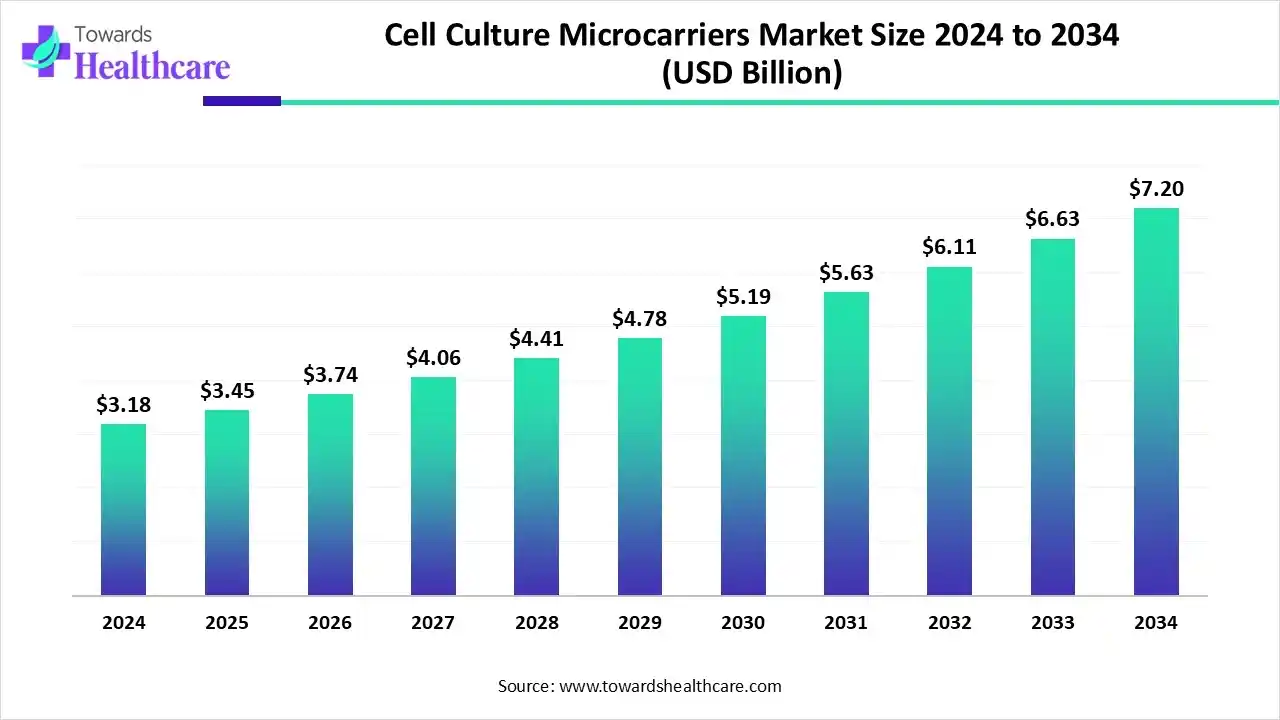
The Complete Study is Now Available for Immediate Access | Download the Sample Pages of this Report @ https://www.towardshealthcare.com/download-sample/5841
Key Takeaways
- North America held a major revenue share of 40% in the market in 2024.
- Asia-Pacific is expected to witness the fastest CAGR of 9.5% during the predicted timeframe.
- By product, the synthetic microcarriers segment dominated the market with a share of 50% in 2024.
- By product, the functionalized/coated microcarriers segment is expected to witness the fastest CAGR of 10.0% in the cell culture microcarriers market over the forecast period.
- By cell type, the stem cells segment contributed the biggest revenue share of 45% in the market in 2024.
- By cell type, the mammalian cells segment is expected to expand rapidly in the market with a CAGR of 8.5% in the coming years.
- By application, the regenerative medicine segment held a dominant revenue share of 40% in the market in 2024.
- By application, the vaccine production segment is expected to grow at the fastest CAGR of 9.0% in the market during the forecast period.
- By technology, the microcarrier suspension culture segment registered its dominance over the global cell culture microcarriers market with a share of 60% in 2024.
- By technology, the fixed-bed/scaffold-based culture segment is expected to show the fastest CAGR of 8.0% over the forecast period.
- By end-user, the biopharmaceutical companies segment held the largest revenue share of 45% in the market in 2024.
- By end-user, the contract manufacturing organisations (CMOs) segment is expected to grow with the highest CAGR of 9.0% in the market during the studied years.
Market Overview & Potential
The cell culture microcarriers market is experiencing robust growth, driven by the rising prevalence of chronic disorders, the growing demand for biopharmaceuticals, and advancements in stem cell research. It encompasses small beads or particles that support the growth of adherent cells in bioreactors and other cell culture systems. They provide a high surface area for cell attachment, enabling scalable cell expansion for applications in regenerative medicine, vaccines, biopharmaceutical production, and research.
Quick Facts Table
| Table | Scope | |
| Market Size in 2025 | USD 3.45 Billion | |
| Projected Market Size in 2034 | USD 7.2 Billion | |
| CAGR (2025 - 2034) | 8.54 | % |
| Leading Region | North America by 40% | |
| Market Segmentation | By Product, By Cell Type, By Application, By Technology, By End-User, By Region | |
| Top Key Players | Rousselot, Inc., Twist Bioscience, Sartorius AG, Kuraray Co., Ltd., Esco VacciXcell, Ritai Bioreactor, Cytocarrier Systems (CCS) Ltd., Merck KGaA, 3D Biotek | |
You can place an order or ask any questions, please feel free to contact us at sales@towardshealthcare.com
What is the Growth Potential Responsible for The Growth of The Cell Culture Microcarriers Market?
The main drivers of the cell culture microcarriers market are the expanding biopharmaceutical sector, the growing demand for cell-based therapies and vaccines, and significant advancements in regenerative medicine and stem cell research. Increased funding for cell-based research, both from government and private entities, further accelerates the market by supporting innovation and clinical trials for cell and gene therapies.
What Are the Growing Trends Associated with the Cell Culture Microcarriers Market?
- Growing demand for cell and gene therapies: The increasing prevalence of chronic diseases is a major driver, accelerating the need for advanced cell-based therapies and vaccines.
- Technological advancements: Innovations in microcarrier materials, such as biodegradable and macroporous options, are improving cell yields and compatibility with advanced systems.
- Increased use of single-use systems and automation: The preference for single-use bioreactors and automated processes is rising, making cell culture more scalable, efficient, and less prone to contamination.
- Focus on 3D cell culture: Microcarriers are critical for 3D cell culture, which allows for higher-density cell growth and more realistic in vitro models, contributing to market growth.
- Government and private investment: Significant investments are being made by both governments and private companies to support biopharmaceutical production and cell therapy research infrastructure, creating a favourable environment for market expansion.
- Biopharmaceutical production dominance: The biopharmaceutical sector is the largest application segment, particularly for vaccine and therapeutic protein production, and is expected to remain the dominant application area.
What is the Growing Challenge in North America held a major revenue share of 40% in the market in 2024.
The main challenges in the cell culture microcarriers market include the high cost of production, technical difficulties with cell attachment and detachment, and ensuring consistency and reproducibility across batches. Additional challenges involve the high cost of serum-free media, limitations in high-density culture production, and the complexity of scaling up advanced cell-based processes.
Become a valued research partner with us - https://www.towardshealthcare.com/schedule-meeting
Regional Analysis
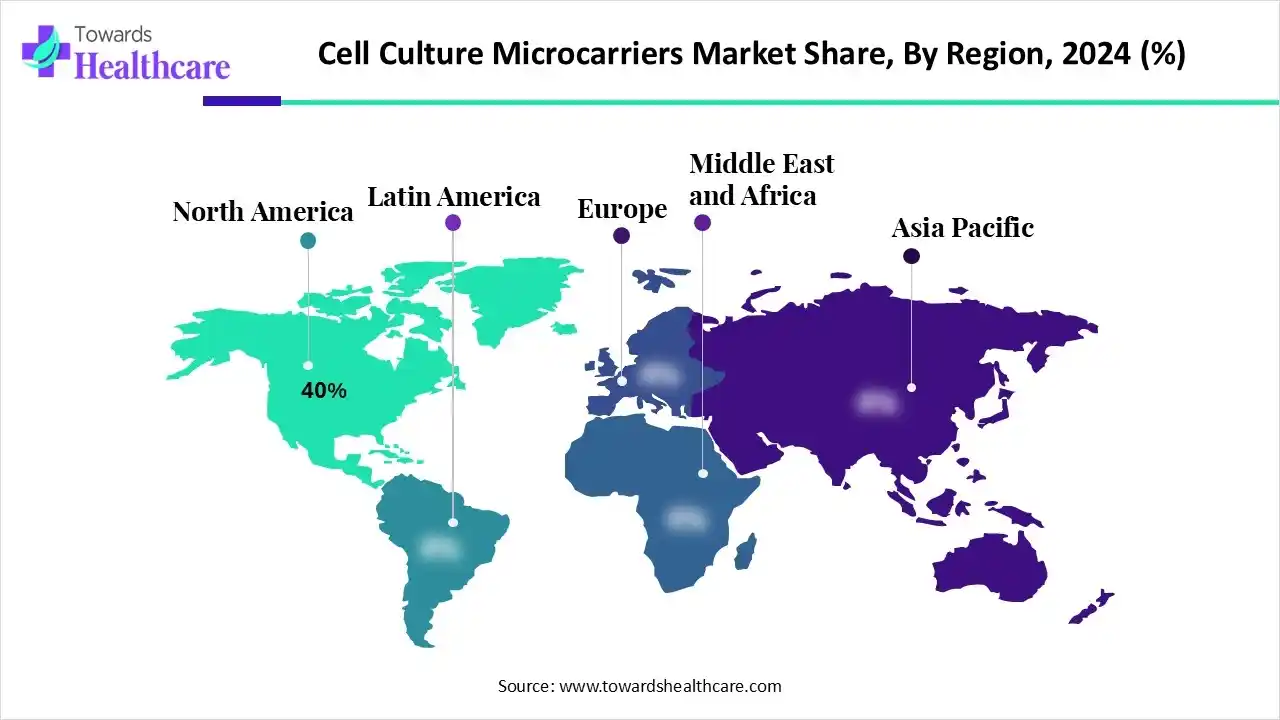
How Did North America Dominate the Cell Culture Microcarriers Market in 2024?
North America held a major revenue share of 40% in the market in 2024. The North American cell culture microcarriers market is robust and expected to grow significantly, driven by its strong biopharmaceutical industry, cell and gene therapy advancements, and investments in automation and single-use bioreactors. The U.S. dominates the market, with growth fueled by the need for large-scale production of vaccines, cell-based therapies, and other biologics.
What Made the Asia Pacific Significantly Grow in The Cell Culture Microcarriers Market In 2024?
Asia-Pacific is expected to witness the fastest CAGR of 9.5% during the predicted timeframe. The Asia-Pacific cell culture microcarriers market is experiencing robust growth, projected to expand at the fastest regional CAGR of up to 25% through 2032. This growth is driven by increasing investments in biotechnology and biopharmaceutical manufacturing, particularly in China, Japan, and India, and supported by government initiatives, expanding applications in regenerative medicine, and technological advancements.
Segmental Insights
By Product,
The synthetic microcarriers segment dominated the market with a share of 50% in 2024. Synthetic microcarriers are manufactured using polymers such as polystyrene, polyethene, and other engineered materials to provide controlled surface properties and mechanical stability. They are widely used in large-scale bioprocessing for cell expansion in vaccine production and biologics manufacturing, as they support reproducibility and easier regulatory compliance in commercial and clinical applications.
The functionalized/coated microcarriers segment is expected to witness the fastest CAGR of 10.0% in the cell culture microcarriers market over the forecast period. Functionalized or coated microcarriers are modified with extracellular matrix proteins, peptides, or bioactive molecules to enhance cell attachment, proliferation, and differentiation. Their ability to mimic the natural cellular environment makes them increasingly important in regenerative medicine, advanced cell therapies, and tissue engineering research. Rising demand for high-performance cell culture systems is driving their adoption.
By Cell Type,
The stem cells segment contributed the biggest revenue share of 45% in the market in 2024. Stem cells require highly controlled microenvironments for optimal growth and differentiation, making microcarriers essential for their large-scale culture. With increasing focus on regenerative medicine, cell therapy, and personalised medicine, the demand for microcarrier-supported stem cell culture is growing rapidly across both academic and commercial biomanufacturing sectors.
The mammalian cells segment is expected to expand rapidly in the market with a CAGR of 8.5% in the coming years. Mammalian cells such as CHO, HEK293, and Vero cells are extensively used in biologics and vaccine production. Their use is critical in the manufacturing of monoclonal antibodies, viral vaccines, and recombinant proteins. The expanding global biopharmaceutical industry is a major driver for this segment.
By Application,
The regenerative medicine segment held a dominant revenue share of 40% in the market in 2024. In regenerative medicine, microcarriers support large-scale expansion of therapeutic cells for tissue repair, cell replacement therapy, and organ regeneration. As research and clinical applications in regenerative therapies grow, especially for neurological, orthopaedic, and cardiovascular disorders, microcarriers are becoming an essential component of scalable cell manufacturing systems.
The vaccine production segment is expected to grow at the fastest CAGR of 9.0% in the market during the forecast period. Microcarriers play a vital role in vaccine production by enabling high-density growth of virus-producing cells such as Vero and MDCK cells. This has become particularly important due to rising global demand for vaccines, pandemic preparedness, and expansion of viral vaccine manufacturing capacities in both developed and emerging markets.
Get the latest insights on life science industry segmentation with our Annual Membership: https://www.towardshealthcare.com/get-an-annual-membership
By Technology,
The microcarrier suspension culture segment registered its dominance over the global cell culture microcarriers market with a share of 60% in 2024. Suspension-based microcarrier culture is widely used in industrial bioprocessing as it allows uniform nutrient distribution, improved oxygen transfer, and efficient scalability. It is commonly used in commercial biologics and vaccine manufacturing facilities, supporting continuous production processes and integration with modern bioreactor systems.
The fixed-bed/scaffold-based culture segment is expected to show the fastest CAGR of 8.0% over the forecast period. Fixed-bed and scaffold-based culture technologies provide a structured environment that closely mimics in vivo tissue architecture. These systems are especially useful for adherent cells and 3D culture applications such as organoid development and tissue engineering. They offer better control over cell differentiation and function, making them valuable in advanced therapy manufacturing and regenerative medicine workflows.
By End-user,
The biopharmaceutical companies segment held the largest revenue share of 45% in the market in 2024. Biopharmaceutical companies use microcarriers extensively for the production of monoclonal antibodies, vaccines, and cell therapies. These companies require scalable, reproducible, and GMP-compliant cell culture systems to meet regulatory and commercial production demands. With the increasing number of biologics and cell-based therapeutics entering clinical trials and commercialisation, microcarriers have become a critical component of modern biomanufacturing operations.
The contract manufacturing organisations (CMOs) segment is expected to grow with the highest CAGR of 9.0% in the market during the studied years. CMOs provide outsourced biomanufacturing and process development services for pharmaceutical and biotech companies. The growing trend of outsourcing manufacturing due to cost advantages and capacity limitations in-house is significantly increasing microcarrier adoption among CMOs worldwide.
Recent Developments
- In October 2025, Cellevate AB announced the launch of Cellevat3d VAX nanofiber microcarriers for adherent cell-based viral vaccine production. The product introduces sustainability, improves scalability, and generates higher yields, enhancing overall manufacturing efficiency.
- In April 2024, Kuraray Co., Ltd. launched polyvinyl alcohol (PVA) hydrogel microcarriers for cell cultures used in regenerative medicine. Kuraray’s microcarriers exhibit higher cell culture efficiency and resist damage when stirred in bioreactors.
Browse More Insights of Towards Healthcare:
The global cell culture vessels market size was evaluated at US$ 4.28 billion in 2024 and is expected to attain around US$ 17.59 billion by 2034, growing at a CAGR of 15.18% from 2024 to 2034.
The global cell culture collagen market size is estimated at US$ 2.31 billion in 2024 and is projected to grow to US$ 2.45 billion in 2025, reaching around US$ 4.19 billion by 2034. The market is projected to expand at a CAGR of 6.15% between 2025 and 2034.
The global cell culture media storage containers market size is calculated at US$ 2.15 in 2024, grow to US$ 2.42 billion in 2025, and is projected to reach around US$ 7.04 billion by 2034. The market is expanding at a CAGR of 12.59% between 2024 and 2034.
The global cell culture media market size is calculated at USD 6.9 billion in 2024, grew to USD 7.69 billion in 2025, and is projected to reach around USD 20.32 billion by 2034. The market is expanding at a CAGR of 11.45% between 2025 and 2034.
The global gene therapy cell culture media market size began at US$ 193.45 billion in 2024 and is forecast to rise to US$ 214.42 billion by 2025. By the end of 2034, it is expected to surpass US$ 541.42 billion, growing steadily at a CAGR of 10.84%.
The Europe cell culture media market is projected to reach USD 1642.05 million by 2034, growing from USD 948.32 million in 2025, at a CAGR of 6.29% during the forecast period from 2025 to 2034.
The global primary cell culture market size is expected to grow from USD 7.41 billion in 2025 to USD 20.62 billion by 2034, with a CAGR of 12.05% throughout the forecast period from 2025 to 2034.
The global bacterial cell culture market size is calculated at US$ 3.43 in 2024, grew to US$ 3.66 billion in 2025, and is projected to reach around US$ 6.56 billion by 2034. The market is expanding at a CAGR of 6.7% between 2025 and 2034.
The global viral vaccine cell culture media market size is calculated at USD 1.83 in 2024, grew to USD 1.94 billion in 2025, and is projected to reach around USD 3.24 billion by 2034. The market is expanding at a CAGR of 5.84% between 2025 and 2034.
The global insect cell lines market size is calculated at US$ 1.15 in 2024, grew to US$ 1.28 billion in 2025, and is projected to reach around US$ 3.39 billion by 2034. The market is expanding at a CAGR of 11.44% between 2025 and 2034.
Cell Culture Microcarriers Market Key Players List
- Rousselot, Inc.
- Twist Bioscience
- Sartorius AG
- Kuraray Co., Ltd.
- Esco VacciXcell
- Ritai Bioreactor
- Cytocarrier Systems (CCS) Ltd.
- Merck KGaA
- 3D Biotek
Segments Covered in The Report
By Product
- Synthetic Microcarriers
- Polystyrene-based
- Polyurethane-based
- Natural Microcarriers
- Collagen-based
- Gelatin-based
- Dextran-based
- Functionalized/Coated Microcarriers
- ECM-coated
- Peptide-coated
By Cell Type
- Stem Cells
- Mammalian Cells
- Insect Cells
- Other Cells
By Application
- Regenerative Medicine
- Vaccine Production
- Biopharmaceutical Production
- Research & Development
By Technology
- Microcarrier Suspension Culture
- Fixed-bed/Scaffold-based Culture
By End-User
- Biopharmaceutical Companies
- Research Institutes
- Contract Manufacturing Organisations (CMOs)
By Region
- North America
- U.S.
- Canada
- Asia Pacific
- China
- Japan
- India
- South Korea
- Thailand
- Europe
- Germany
- UK
- France
- Italy
- Spain
- Sweden
- Denmark
- Norway
- Latin America
- Brazil
- Mexico
- Argentina
- Middle East and Africa (MEA)
- South Africa
- UAE
- Saudi Arabia
- Kuwait
Immediate Delivery Available | Buy This Premium Research @ https://www.towardshealthcare.com/checkout/5841
Access our exclusive, data-rich dashboard dedicated to the healthcare market - built specifically for decision-makers, strategists, and industry leaders. The dashboard features comprehensive statistical data, segment-wise market breakdowns, regional performance shares, detailed company profiles, annual updates, and much more. From market sizing to competitive intelligence, this powerful tool is one-stop solution to your gateway.
Access the Dashboard: https://www.towardshealthcare.com/access-dashboard
About Us
Towards Healthcare is a leading global provider of technological solutions, clinical research services, and advanced analytics, with a strong emphasis on life science research. Dedicated to advancing innovation in the life sciences sector, we build strategic partnerships that generate actionable insights and transformative breakthroughs. As a global strategy consulting firm, we empower life science leaders to gain a competitive edge, drive research excellence, and accelerate sustainable growth.
You can place an order or ask any questions, please feel free to contact us at sales@towardshealthcare.com
Europe Region: +44 778 256 0738
North America Region: +1 8044 4193 44
APAC Region: +91 9356 9282 04
Web: https://www.towardshealthcare.com
Our Trusted Data Partners
Precedence Research | Statifacts | Towards Packaging | Towards Automotive | Towards Food and Beverages | Towards Chemical and Materials | Towards Consumer Goods | Towards Dental | Towards EV Solutions | Nova One Advisor | Healthcare Webwire | Packaging Webwire | Automotive Webwire | Nutraceuticals Func Foods | Onco Quant | Sustainability Quant | Specialty Chemicals Analytics
Find us on social platforms: LinkedIn | Twitter | Instagram | Medium | Pinterest


Legal Disclaimer:
EIN Presswire provides this news content "as is" without warranty of any kind. We do not accept any responsibility or liability for the accuracy, content, images, videos, licenses, completeness, legality, or reliability of the information contained in this article. If you have any complaints or copyright issues related to this article, kindly contact the author above.
